Concrete Sleeper Retaining Wall Cost Per Metre (Canberra 2026)
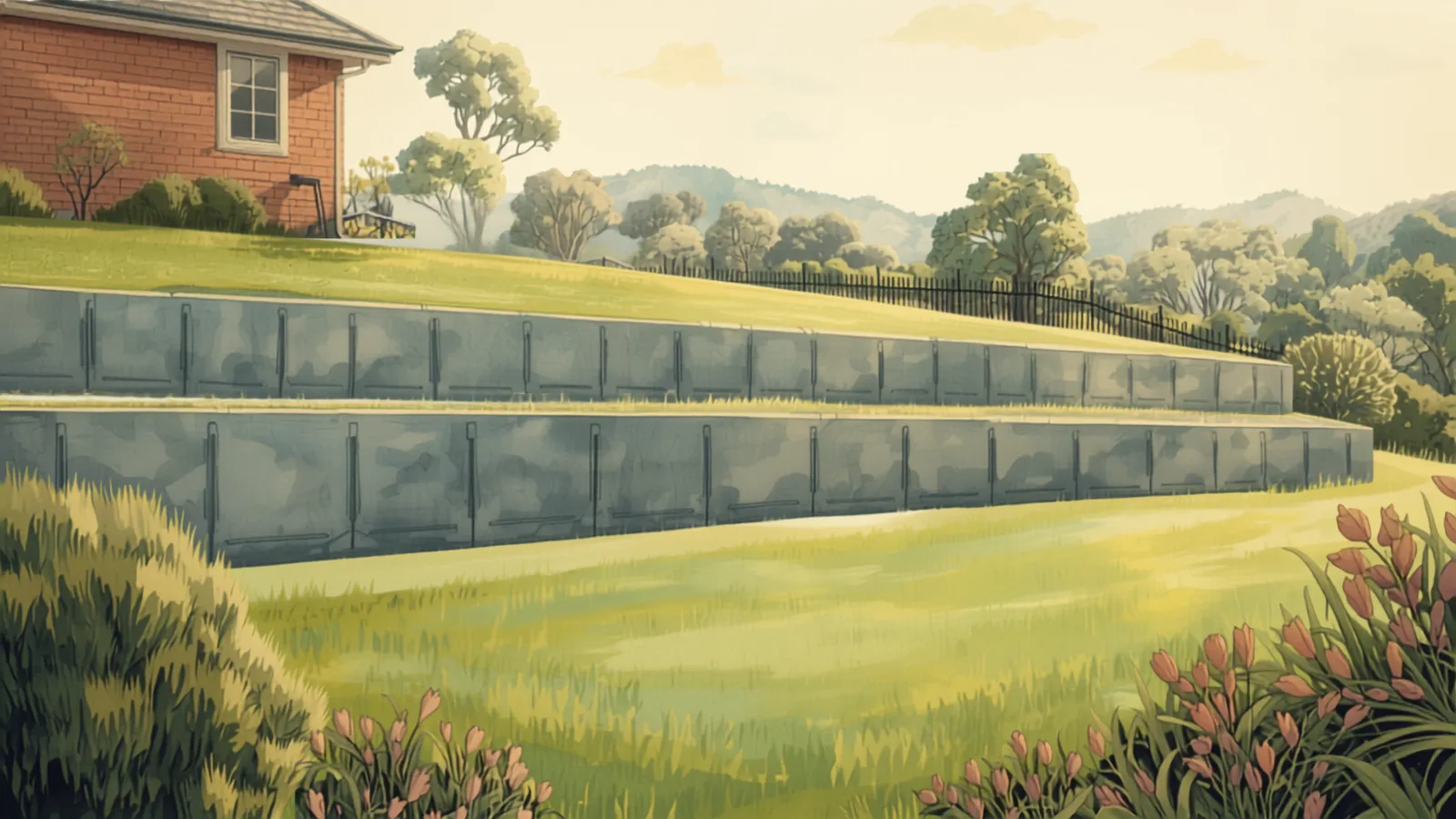
A concrete sleeper retaining wall costs $330–$660 per lineal metre in Canberra in 2026, with most suburban jobs landing near $440. That is the number Canberra builders actually quote in — and it is not the same number as a price per square metre, which is what a lot of people go looking for. This guide gives you the full six-material comparison first, then goes deep on concrete sleeper, and settles the per-metre versus per-square-metre question properly so you can read any quote you are handed.
Six wall types, metre for metre
Every band below is per lineal metre — the distance the wall runs along the ground, not the area of its face. This is how retaining walls are priced in Canberra, and comparing materials on this basis is the fastest way to see what your choice of wall is really costing you.
| Wall type | Low | Typical | High |
|---|---|---|---|
| Timber sleeper wall (per lm) | $220 | $350 | $495 |
| Concrete sleeper wall (per lm) | $275 | $440 | $660 |
| Block / besser wall (per lm) | $330 | $550 | $825 |
| Sandstone wall (per lm) | $385 | $605 | $770 |
| Boulder wall (per lm) | $275 | $440 | $660 |
| Gabion wall (per lm) | $330 | $550 | $880 |
Canberra 2026 bands, from the retaining wall cost guide.
Concrete sleeper sits second-cheapest to build and first for the number of Canberra walls it ends up on. It opens at $275 a metre where timber opens at $220, and lands under block, sandstone and gabion almost everywhere else — which is why it has quietly become the default for a suburban cut-and-fill backyard.
Per lineal metre or per square metre? Here is the honest conversion
Both search terms are common, and both describe the same wall. Builders quote per lineal metre because that is how a wall is built — post, panel, post, panel — while buyers often think in square metres because that is the face they can see when they stand in front of it.
The arithmetic linking them is simple. One lineal metre of wall has a face area equal to its height in metres. So the square-metre figure is the per-lineal-metre rate divided by the wall height.
At exactly one metre high the two are the same number: a wall quoted at $440 a lineal metre is $440 per square metre of face. Below a metre, the square-metre figure comes out higher than the metre rate. Above a metre, it comes out lower.
And here is the trap. The per-lineal-metre rate is not a constant you can carry across heights. A taller wall needs deeper footings, heavier posts, thicker sleepers, more excavation and, past a point, certified engineering. Doubling the height does more than double the metre rate. Converting a one-metre wall’s rate into a square-metre figure and then applying it to a two-metre wall will understate the job badly. Use the square-metre view to sanity-check one quote against itself; never use it to price a wall of a different height.
What moves a concrete sleeper quote inside its band
Height. The single biggest dial. Height sets post size, post embedment depth, sleeper thickness and whether an engineer needs to sign the wall off at all. A 500mm garden edge and a 1.5m cut are different products wearing the same name.
What is under the wall. Canberra ground is not uniform. A post hole through clay is one price; the same hole through rock is another, and the difference shows up as machine time and broken auger teeth. Sloping ground that has to be benched before anything is set costs more again.
Access. If a machine can drive to the wall line, posts go in fast. If sleepers have to be carried through a side gate one at a time, that labour is in your quote whether it is itemised or not — and on concrete sleepers, which are heavy, it is a bigger line than people expect.
Drainage. Aggregate backfill and a drainage line behind the wall runs $33–$88 per lineal metre and belongs on every wall that retains real soil. It is the cheapest insurance on the job; see wall height, engineering and ACT approvals for why walls fail without it.
Engineering. Structural design and certification runs $550–$2,200 per job when the wall needs it. That is a per-job cost, not a per-metre one, which is why it hits short tall walls hardest.
Finish. Plain grey, woodgrain and rockface sleeper faces are priced differently by every supplier. It is a genuine choice, not an upsell — but ask for the price both ways before you decide.
Concrete sleeper against the other five
Against timber at $220–$495 a metre, concrete costs more on day one and wins on the day the timber would have needed replacing. The full argument, including what a rebuild costs, is in timber sleeper retaining wall cost.
Against block or besser at $330–$825, concrete sleeper is usually cheaper and much faster to build, because a sleeper wall is a kit of parts and a block wall is masonry with footings and core fill. Block wins on curves, corners and rendered finishes.
Against sandstone, boulder and gabion — $385–$770, $275–$660 and $330–$880 respectively — the decision is mostly aesthetic and site-specific rather than structural. Rockwall, sandstone and gabion walls covers when each of those genuinely beats a sleeper wall.
Reading a per-metre quote without getting caught
A per-metre rate is only comparable if both quotes state the same wall. Before you line three of them up, make each one commit to: the wall height, the post centres and post section, the sleeper thickness, the depth the posts go into the ground, whether drainage is included, and whether engineering is in the price or extra. Two quotes at the same dollars per metre can be two different walls, and the cheaper one is often the one that left the drainage out.
Then check the whole-job number against the project bands rather than against the metre rate — those totals include set-up, excavation and disposal that no lineal rate carries. How to compare Canberra retaining wall quotes works through three quotes line by line.
Frequently asked questions
Is a concrete sleeper wall quoted per lineal metre or per square metre?
Per lineal metre, almost always — $330–$660 per lineal metre in Canberra for 2026. Builders price the way the wall is built: post, panel, post, panel. If you want a square-metre view, divide the metre rate by the wall height; at one metre high they are the same number.
What should a per-metre concrete sleeper price actually include?
At minimum: galvanised posts at stated centres, sleepers of a stated thickness, excavation for the post holes, concrete to set the posts, and backfill. Drainage is often a separate $33–$88 per lineal metre line, and engineering certification is a per-job cost of $550–$2,200 when the wall needs it. If a quote does not name those items, you cannot compare it to one that does.
Why does the metre rate jump so much between a low and a high wall?
Because height changes the whole build, not just the sleeper count. Taller walls need bigger posts set deeper, thicker sleepers, more excavation and often an engineer. That is why you cannot take a rate quoted for a low wall and stretch it over a tall one — the $275 end of the band and the $660 end are rarely the same height of wall.
Is concrete sleeper the cheapest wall per metre in Canberra?
Second cheapest. Timber sleeper starts lower at $220 a lineal metre against $275 for concrete. Concrete sleeper is cheaper than block at $330, gabion at $330 and sandstone at $385, and it is level with boulder walls at $275 — but boulder pricing is far more site-dependent.
← Back to Retaining wall cost Canberra hub