Deck replacement cost on the Gold Coast
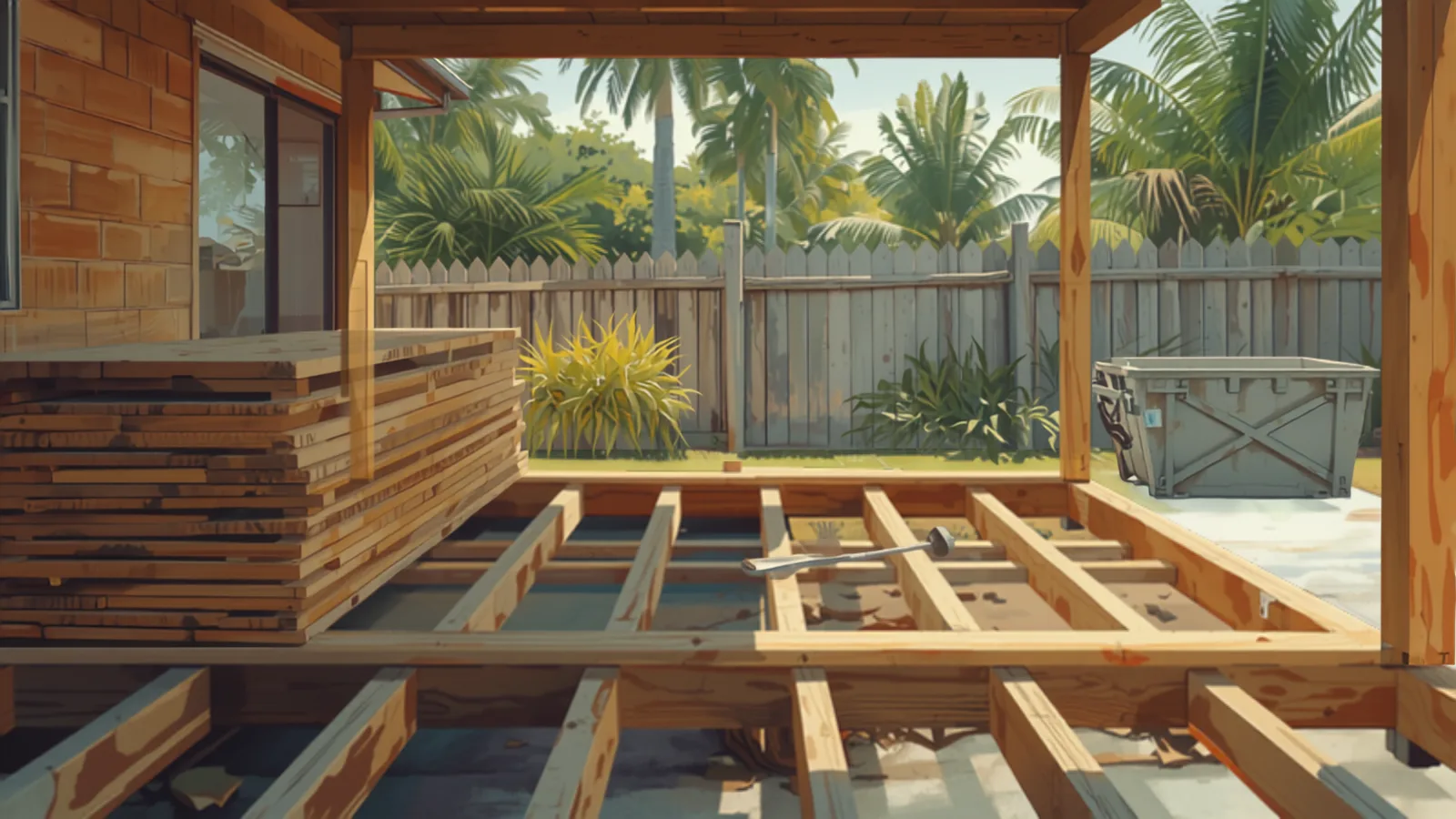
Replacing a deck on the Gold Coast means two numbers: $20 to $54 per square metre to remove the old one, and $175 to $590 per square metre to build the new one. On a typical 24 square metre deck that is roughly $5,000 to $15,000 all in.
What replacement costs
- Demolition and removal — $20 to $54 per square metre, typically $34. About $816 on a 24 sqm deck.
- Rebuild, treated pine — $175 to $345/sqm, typically $255.
- Rebuild, merbau — $295 to $540/sqm, typically $410.
- Rebuild, spotted gum — $345 to $590/sqm, typically $470.
- Rebuild, composite — $275 to $540/sqm, typically $390.
By deck size, rebuilding in hardwood: a small 15 sqm deck is $4,900 to $9,800, a medium 25 sqm deck $7,850 to $15,700, and a large 40 sqm deck $12,750 to $25,500. Add demolition to each.
Two things to note about how those numbers behave. Demolition is cheap relative to the rebuild — on a typical job it is under ten per cent of the total, which means it is rarely worth contorting a decision to avoid it. And the rebuild rate is the same rate you would pay for a deck on a bare site, because once the old structure is gone the builder is starting from the same place either way.
What does differ is what the demolition uncovers. A replacement quote given before anything is lifted is an estimate on the visible structure, and footings, drainage or slab conditions underneath can change it. A good builder will say so upfront and give you a figure for the likely variations rather than a single number that will move. A quote that promises certainty on a deck nobody has opened is the one to be careful with.
The line between repair and replace
This is the whole decision, and it is settled underneath rather than on top.
The boards are the cheap part and the visible part, which is why people judge a deck by them and get the answer wrong in both directions. Grey, splintered, cupped boards on a sound frame are a restoration job — that runs $24 to $59 per square metre and is covered in our deck restoration cost guide. A pristine-looking surface on a frame eaten from below is a replacement, whatever it looks like from the back door.
Three tests, none of which need a tradesperson:
- Bounce. Walk the middle of each span. Movement or give means joists or bearers have lost strength, or spacing was wrong from the start.
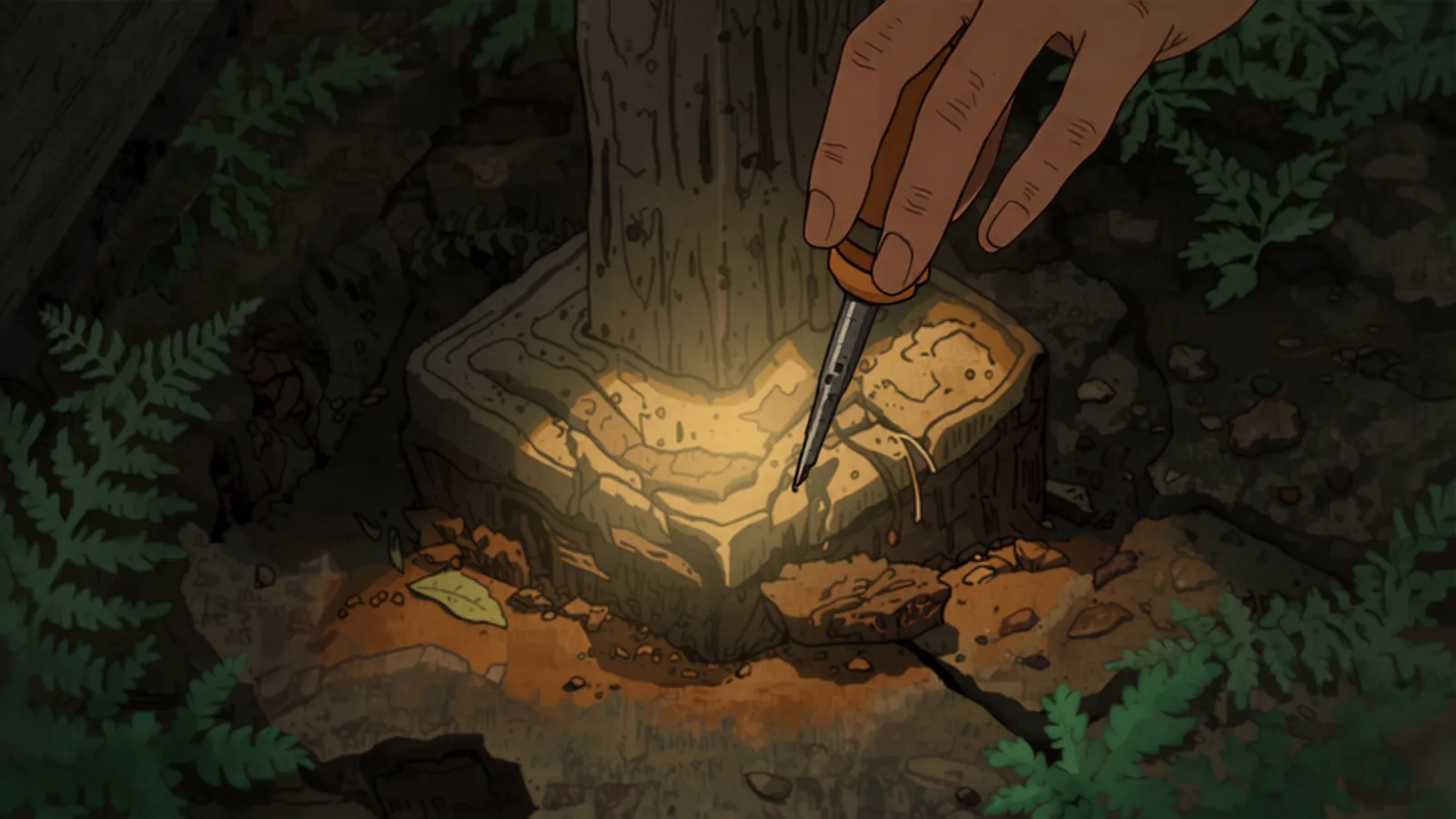
- The screwdriver test at ground level. Push a screwdriver into each post where it meets the ground and into the bearer ends. Sound timber resists. If it sinks in, that is rot or termite damage and it does not stop where you can see it.
- Level. Sight along the deck edge from one corner. A visible drop means a footing has failed or a post has gone.
Any one of those failing puts you in replacement territory. All three passing means restoration will get you another decade.
Why Gold Coast decks fail early
Decks here have a harder life than almost anywhere in the country, and they fail in three predictable ways.
Termites. South-east Queensland carries some of the highest termite pressure in Australia, and a deck substructure is a timber structure in ground contact — the most exposed thing on the property. Where a deck fails structurally here, this is the most common reason. It is almost always an inadequate treatment level on the original frame, and it is invisible until the damage is done.
Post bases. Timber posts set directly into concrete or soil hold moisture at the junction and rot from the inside out. Posts on galvanised stirrups, held clear of the ground, last decades longer. On any deck built before about 2005 it is worth checking which you have.
Undersized framing. A deck built by someone working to the wrong span table, or to none, develops bounce within a few years. It is not a maintenance failure and no amount of restoration fixes it.
Coastal decks add salt corrosion on fixings and joist hangers, which can fail a frame whose timber is still perfectly sound.
A worked example: 24 square metres in Coomera
A 15-year-old merbau deck, 700mm off the ground. Boards look tired but serviceable. The screwdriver goes into two post bases and one bearer end, and there is noticeable bounce mid-span.
- Demolition and removal — 24 sqm at $34, about $816, including skip.
- New substructure — posts on stirrups, treated bearers and joists at correct spacing, concrete footings. Roughly $2,900.
- Merbau boards and stainless fixings — about $3,400.
- Labour — framing and laying, around $3,800.
- Three steps at $145 to $390 each — about $700.
Near $11,600 all up. Restoration on the same deck would have been around $940 and would have bought perhaps two years before the frame gave up entirely — money spent on the top of something that was already failing.
The instructive part is the counterfactual. Had the original deck been built with posts on stirrups and a properly treated frame, at maybe $600 more in 2011, it would still be sound and this would have been a $940 restoration rather than an $11,600 rebuild.
How long it takes, and what it is like
Every other decision on this page assumes you have accepted a week or two of disruption. Worth knowing what that actually looks like before you commit.
Demolition — half a day to a day. Loud, dusty, and the skip arrives. On a 24 square metre deck the old structure is usually gone by lunchtime on day one.
Footings — a day, then a wait. Holes dug, posts set, concrete poured. The concrete then needs to cure before anything loads it, which on a Gold Coast summer week is a couple of days and in winter can be longer. This is the stage that makes a deck a two-week job rather than a one-week one, and it is the stage most likely to be quietly compressed by a builder in a hurry.
Framing — one to two days. Bearers, joists, the whole structure that decides how the deck feels in five years.
Boards — one to two days. The fast, visible part, which is why people underestimate the whole job.
Steps, balustrade and finishing — a day or more depending on how much there is.
Realistically that is five to ten working days spread across two to three calendar weeks once weather and curing are allowed for. Add time again if building approval is involved, since certification has its own timeline and inspections have to be booked around the build rather than the other way round.
Practically: the back of the house is a building site for that period, the yard loses space to timber stacks and offcuts, and if the deck is your main access you will be using another door. Rain stops board-laying entirely, and a Gold Coast wet-season fortnight can double the calendar time without adding a single working day. If the deck matters for a specific date — Christmas, a party, a rental listing — start six weeks out, not three.
Partial replacement
Sometimes only part of a deck has gone, and it is worth asking about before committing to the whole thing.
Replacing boards while keeping a sound frame is common and sensible — you are paying for boards, fixings and labour but not demolition of the substructure or new footings. Expect roughly half to two-thirds of a full rebuild per square metre.
Replacing a failed section of frame while keeping the rest is harder to price and harder to do well. It can be the right answer where one corner has gone and the rest is genuinely sound, but the join between old and new framing is a weak point, and a builder who is confident about it should be able to explain how they are handling it.
What rarely works is replacing boards over a frame you have not inspected. New boards on a failing substructure is the most expensive mistake in this trade, because you pay for the boards twice.
Rebuild the same, or change?
A replacement is the one moment where changing material costs you nothing extra in demolition, so it is worth thinking about rather than defaulting.
If the old deck was pine and you never kept up with the oiling, that pattern will repeat — composite or a harder timber is worth the difference. If the old deck was hardwood and you liked it, rebuild in hardwood, but insist on stirrups and the correct substructure treatment so the next one lasts. The ten-year running-cost comparison is in our composite versus timber decking cost guide.
Also worth revisiting: size and height. Extending while the frame is off is far cheaper than extending later. And if the old deck was under a metre and the new one goes above it, you cross into building approval territory — which is a real cost and a real timeline, not a formality.
Approval, licensing and what to ask
In Queensland, a deck more than a metre above natural ground level generally needs building approval through a licensed building certifier. A like-for-like replacement at the same height on the same footprint may be simpler than a new build, but it is not automatically exempt — confirm rather than assume. Queensland Building and Construction Commission licensing applies to building work above $3,300, which every replacement exceeds, so check the licence on the QBCC register before any deposit. If your block is at the Tweed Heads end of the territory it is New South Wales, with a different approval pathway and a different licensing body.
Five things to pin down in the quote:
- Demolition and disposal included, and whether a skip is in the price
- Substructure specification — post fixing method, treatment level, joist spacing
- Footing type and depth, given the soil on your block
- Whether approval and certification are the builder's job or yours
- What happens if they open it up and find worse than expected
Steps and balustrade are usually quoted as separate lines rather than folded into the per-square-metre rate, and on a deck above a metre the balustrade is required rather than optional — the figures are in our deck steps and balustrade cost guide.
Frequently asked questions
How much does it cost to replace a deck on the Gold Coast?
Demolition runs $20 to $54 per square metre and the rebuild $175 to $590 depending on material. A typical 24 sqm deck lands around $5,000 to $15,000 all in, with hardwood in the middle of that.
Should I repair or replace my deck?
It depends on the frame, not the boards. Grey or splintered boards on a sound substructure are a restoration job at $24 to $59 per square metre. Bounce underfoot, soft post bases or a dropped corner mean replacement.
How can I tell if my deck frame has failed?
Three checks: walk mid-span for bounce, push a screwdriver into the post bases and bearer ends, and sight along the deck edge for a drop. Any one failing puts you in replacement territory.
Why do decks fail early on the Gold Coast?
Termites in an inadequately treated substructure are the most common cause, followed by posts set directly into ground rather than on galvanised stirrups, and undersized framing. Coastal decks also lose fixings to salt corrosion.
Can I replace just the boards?
Yes, if the frame is genuinely sound — roughly half to two-thirds of a full rebuild per square metre, since you skip demolition and footings. New boards over a failing substructure means paying for the boards twice.
← Back to Gold Coast decking cost guide hub