Deck restoration cost on the Gold Coast
Sanding and oiling a deck on the Gold Coast costs $24 to $59 per square metre, typically $39. On a standard 24 square metre deck that is $576 to $1,416 — and in this climate it is a recurring cost rather than a one-off.
What restoration costs
- Sanding and oiling — $24 to $59 per square metre, typically $39. A 24 sqm deck runs $576 to $1,416, usually near $940.
- Old deck demolition and removal — $20 to $54 per square metre, typically $34. The number that matters when restoration stops making sense.
The spread is wide because "restoration" covers everything from a clean and a fresh coat through to a full strip-back, board replacement and re-oil. Establish which one you are being quoted before comparing anything.
As a rough guide to where in the band you sit: a deck oiled within the last 18 months that has simply lost its sheen needs a clean and a maintenance coat, and sits at the bottom. A deck that has gone uniformly grey needs a full sand back to fresh timber and sits at the top. A deck with cupped or split boards, or one that has been painted and now needs stripping, sits above the band entirely and should be quoted as a job rather than a rate.
Deck size cuts the other way to most trades. Restoration is priced per square metre and the setup is modest, so the rate barely improves with size — a 40 sqm deck costs close to twice a 20 sqm one. What does move the rate is access and complexity: an elevated deck needing scaffold, a lot of edge work around posts and planters, or boards laid on a diagonal all add hand-sanding time that a flat rate does not anticipate.
What is actually involved
A proper restoration runs in five stages, and a cheap quote is usually one that skips two of them:
- Clean. Removing mould, dirt and old oil residue. On the Gold Coast the mould is not optional — the wet season puts it on every deck, particularly in shade.
- Repairs. Replacing split, cupped or rotten boards, re-fixing loose ones, punching down proud nails or screws before the sander touches them.
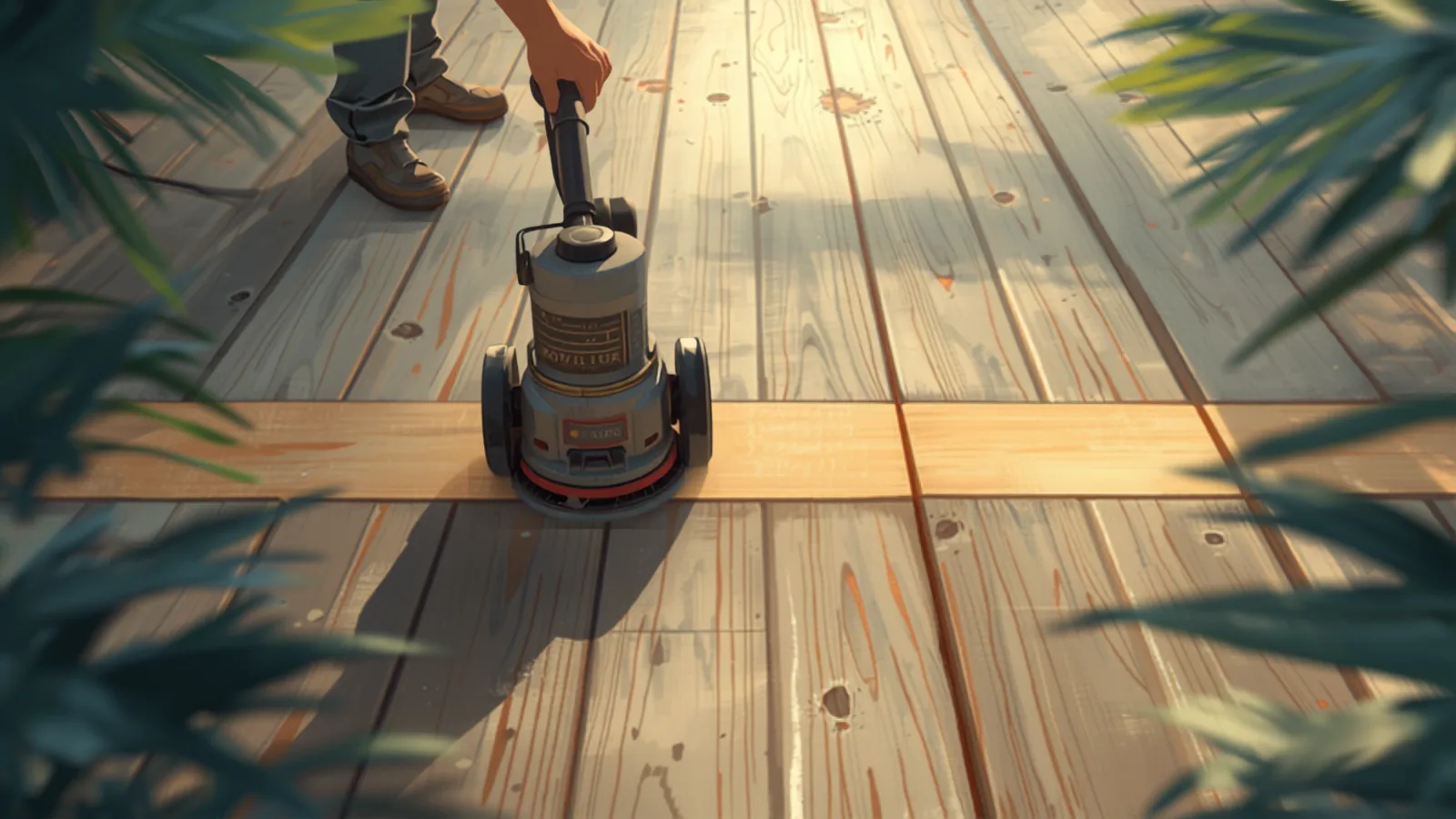
- Sanding. Taking the grey oxidised surface back to fresh timber. Usually two or three grit passes, plus edge and corner work by hand.
- Preparation. Vacuuming and tack-clothing the whole surface. Oil over dust is a finish that will not last.
- Oiling. Two coats minimum, with drying time between. The product matters more than people expect.
Sanding is the labour-heavy stage and the one most often cut. A deck that has been oiled straight over a wash rather than sanded looks acceptable for about four months, then goes patchy as the old finish underneath fails unevenly.
How often, on the Gold Coast
More often than almost anywhere else in the country, and the reason is UV rather than rain.
Subtropical sun degrades the oil film and breaks down the lignin in the timber surface, which is what turns hardwood silver. A north or west-facing deck in full sun here wants recoating every 12 to 18 months. A south-facing or shaded deck stretches to two or three years. Add salt within a few streets of the water and the interval shortens again.
The useful signal is water. Splash some onto the boards — if it beads, the finish is intact. If it soaks straight in and darkens the timber, the oil has gone and the surface is now exposed. Checking that every six months costs nothing and it is the difference between a re-coat and a full sand.
That distinction is where the money is. A deck caught before the finish fails needs a clean and a coat, at the bottom of the band. A deck left two years past that point has oxidised and needs the full sand, at the top. Same deck, more than double the price, and the only variable is when you looked.
A worked example: 24 square metres in Nerang
A merbau deck, six years old, north-facing, last oiled about three years ago. Now uniformly grey with two split boards near the steps.
- Clean and mould treatment — half a day, roughly $250.
- Two replacement boards, supplied and fitted — about $180.
- Full sand, three passes plus hand-work at the edges — the bulk of it, around $550.
- Two coats of decking oil, product and labour — about $420.
Around $1,400 all up, which is the top of the band and correct for a deck at this stage. Had the same deck been caught at 18 months — a clean and a single maintenance coat, no sanding — it would have been closer to $600.
Over ten years the difference compounds. Restoring every 18 months at $600 is roughly $4,000. Letting it go and doing a full sand every three years at $1,400 is roughly $4,700, and the deck spends most of that decade looking tired. The maintenance schedule is cheaper and the deck looks better — which is not the trade-off people expect.
Oil, stain or decking paint
Three finishes, three different maintenance stories.
Decking oil penetrates rather than sitting on top, so it fails gradually and evenly. When it is due you re-coat. No stripping, no peeling. It is the standard choice for hardwood here and the easiest to live with.
Stain sits partly on the surface and carries more pigment, which buys better UV protection and a longer interval. The trade-off is that it eventually flakes rather than fading, and flaking has to be sanded off completely before recoating.
Decking paint gives the longest interval and the most colour choice, and it is the hardest to undo. Once painted, a deck is effectively always painted — going back to natural timber means a full strip. Fine on treated pine, rarely the right call on merbau or spotted gum.
One Gold Coast-specific note: whatever you use, it wants applying in the drier months. Oiling into humidity, or within a day of rain, gives a finish that stays tacky and traps moisture underneath.
Doing it yourself
On a $576 to $1,416 job this is a fair question, and the honest answer is that it is genuinely doable — but it is a weekend, not an afternoon, and the sanding is where people come unstuck.
What it costs. A drum or orbital deck sander hires for roughly $80 to $140 a day, plus abrasives at $40 to $80 for a deck this size. Decking oil for 24 square metres, two coats, runs about $150 to $250 depending on the product. Add a mould treatment and a few brushes and you are near $350 to $500 against $940 to have it done. The saving is real but it is not enormous, and it is entirely your labour.
What it takes. Budget a full day for cleaning and sanding on 24 square metres, and a second day across the two oil coats with drying time between. Edges, corners and the boards against the house all need hand-sanding, which is slower than the open field and is the part that makes it a two-day job rather than one.
Where it goes wrong. Three failure modes, in order of how often they happen. Gouging — a drum sander left stationary for a second cuts a dish into the board that no amount of later sanding removes, so keep it moving and start with a finer grit than you think you need. Oiling into humidity — the subtropical wet season leaves a finish that stays tacky and traps moisture underneath, so wait for a dry stretch and stay well clear of rain for 48 hours either side. And skipping the vacuum before oiling, which locks sanding dust into the finish and shows up as a gritty surface you then have to sand off again.
The case for paying someone is not really the tools, it is that a professional sands 24 square metres properly in a few hours because they have done it a hundred times. If the deck is small, flat and accessible, do it yourself. If it is elevated, has a lot of edge work, or you have never run a sander, the $500 difference buys a better finish than most first attempts produce.
When to stop restoring
Restoration is worth it while the structure is sound. The tell is underneath, not on top.
Worth restoring: surface greying, splinters, cupped or split boards, a tired finish, even a few rotten boards. Surface problems on a sound frame are exactly what restoration is for.
Stop and replace when the substructure has gone — bearers or joists that are soft, movement or bounce underfoot, posts rotting at ground level, or a deck that has visibly dropped at one corner. In south-east Queensland the most common cause is termites in an inadequately treated frame, and no amount of surface work addresses it.
The arithmetic is straightforward: demolition and removal runs $20 to $54 per square metre, and a new merbau deck is $295 to $540 per square metre. If a deck needs more than a third of its boards replaced, or if the frame is compromised at all, restoration money is better put toward the rebuild. Our deck replacement cost guide sets out where that line sits.
Getting it quoted right
- Sanded or just cleaned before oiling — the single biggest quality variable
- How many grit passes, and whether edges and corners are hand-worked
- Board repairs included or extra, and at what rate
- Which product, and how many coats
- Whether the substructure has been inspected, not just the surface
That last one is worth insisting on. A restorer who has not looked underneath is quoting on the assumption that the deck is worth restoring, and on a Gold Coast deck older than about eight years that assumption is worth checking before you spend $1,400 on the top of a frame that needs replacing. If you are weighing restoration against a rebuild in a different material, the ten-year comparison is in our composite versus timber decking cost guide.
Frequently asked questions
How much does it cost to restore a deck on the Gold Coast?
$24 to $59 per square metre for sanding and oiling, typically $39. A 24 sqm deck runs $576 to $1,416, usually near $940 — the top of the band applies once the timber has fully greyed and needs a full sand.
How often should a deck be oiled on the Gold Coast?
Every 12 to 18 months for a north or west-facing deck in full sun, and every two to three years for a shaded or south-facing one. Salt air within a few streets of the water shortens it further.
How do I know when my deck needs recoating?
Splash water on it. If it beads, the finish is intact. If it soaks in and darkens the timber, the oil has gone. Catching that point means a clean and a coat rather than a full sand — often half the price.
Can a deck be oiled without sanding?
It can, and it looks fine for about four months before going patchy as the old finish fails unevenly underneath. Sanding is the labour-heavy stage and the one cheap quotes skip.
When is a deck too far gone to restore?
When the substructure has gone — soft bearers or joists, bounce underfoot, posts rotting at ground level, or a dropped corner. Surface problems on a sound frame are worth restoring; a compromised frame is not.
← Back to Gold Coast decking cost guide hub