Composite vs timber decking cost on the Gold Coast
Composite decking runs $275 to $540 per square metre on the Gold Coast, timber $175 to $590 depending on species. The bands overlap almost completely, which means the upfront price will not decide this for you. What happens over the following decade will.
The upfront numbers
- Treated pine — $175 to $345/sqm, typically $255. Cheapest to build, most demanding to keep.
- Composite — $275 to $540/sqm, typically $390.
- Merbau — $295 to $540/sqm, typically $410. The Gold Coast default hardwood.
- Spotted gum — $345 to $590/sqm, typically $470. Hardest and most stable of the common choices.
Composite sits between pine and hardwood at the typical figure and overlaps both at the edges. On a 24 square metre deck the difference between composite at $390 and merbau at $410 is around $480 across the whole job — which is inside the noise of two quotes, and nowhere near enough to decide on.
What each actually costs to own
The real difference is maintenance, and on the Gold Coast that gap is wider than it would be further south.
Timber needs sanding and oiling at $24 to $59 per square metre. In this climate that is every 12 to 24 months for a deck in full sun, stretching to three years for one that is shaded and sheltered. On a 24 sqm deck, call it $600 to $1,400 a time. Over ten years, assuming a coat every second year, that is somewhere between $3,000 and $7,000 — comfortably more than the deck cost to build if you went with pine.
Composite needs washing. No oil, no sanding, no recoating. Budget a few hundred dollars of your own time and a stiff brush, or a pressure wash on a low setting once a year.
Run that over ten years on a 24 sqm deck and composite at $9,400 to build with near-zero upkeep lands well under merbau at $9,800 to build plus $3,000 to $7,000 in oil. The upfront comparison favours timber slightly. The ten-year comparison is not close.
Where that argument breaks down
Three honest caveats, because the ten-year case is not the whole story.
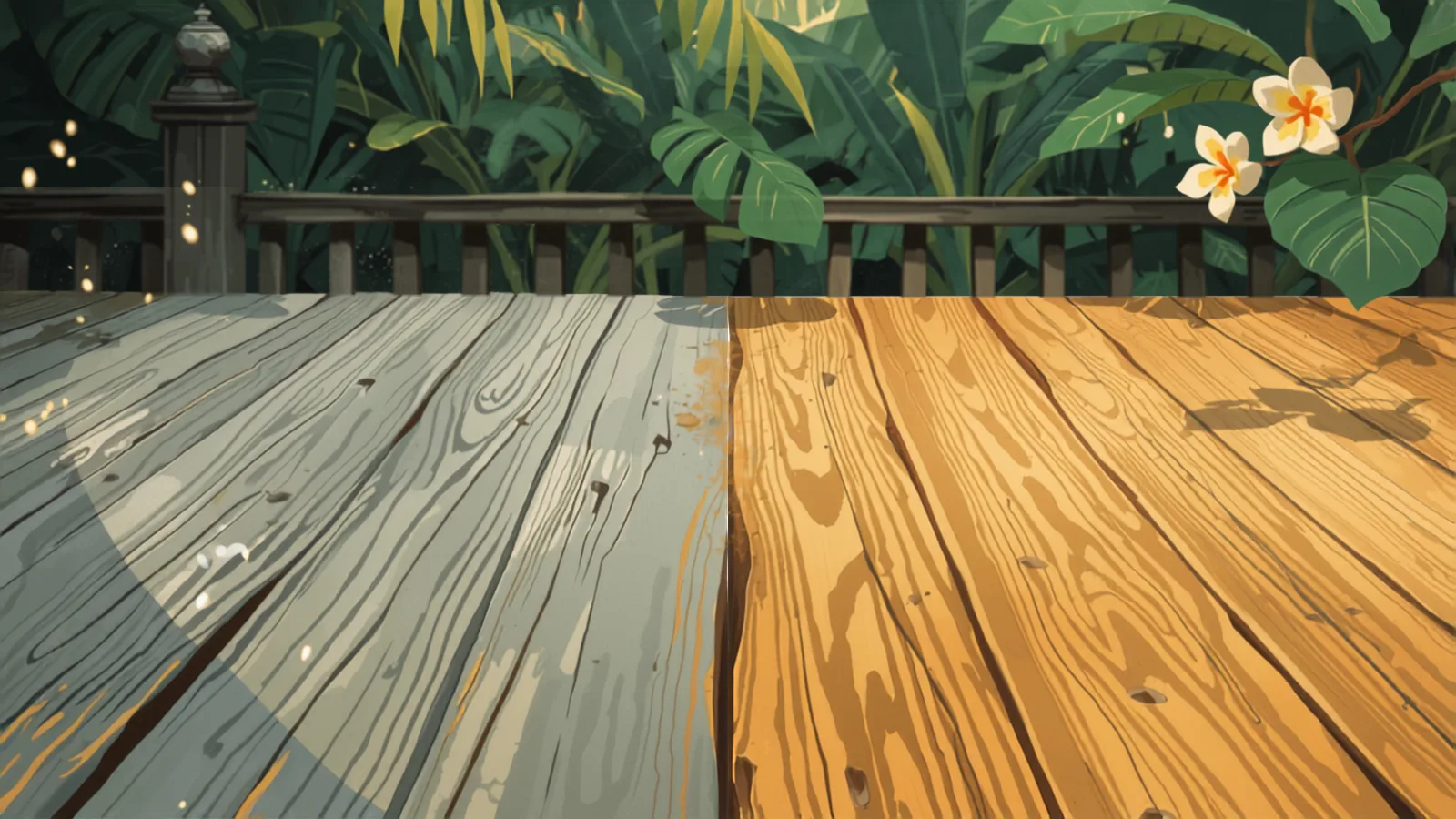
The first is that plenty of people never oil their timber deck and are perfectly happy. Left alone, hardwood weathers to a silver grey and keeps its structural integrity for decades. What you lose is the colour, not the deck. If the grey look suits you, timber's running cost drops to near zero and the whole comparison inverts.
The second is heat. Dark composite boards get significantly hotter underfoot in direct sun than timber does, and on the Gold Coast that is not a marginal complaint — a north or west-facing deck in January can be genuinely unusable barefoot. Lighter composite colours help. So does shade. It is the most common regret people report and it does not show up in any cost comparison.
The third is that composite is not repairable in the way timber is. A gouged or stained hardwood board can be sanded. A damaged composite board is replaced, and matching a board to a deck laid five years ago is often not possible because ranges change.
Salt, humidity and termites
Three local pressures push the decision differently.
Salt air — within a few streets of the water at Broadbeach, Burleigh or Palm Beach, corrosion on fixings matters more than the board material. Stainless fixings are worth the premium on either choice, and they are a bigger determinant of how the deck ages than composite versus timber is.
Humidity and mould — the subtropical wet season grows mould on anything. Composite resists it better on the surface but is not immune, particularly in shade where airflow is poor. Timber that is regularly oiled resists it well; timber that is neglected does not.
Termites — this is the one people get wrong. Composite boards are not a termite meal, but almost every composite deck sits on a timber substructure, which is. Choosing composite does not remove the termite question, it just moves it out of sight. The substructure treatment level matters exactly as much either way.
A worked example: 24 square metres, ten years
Same deck, same footprint, two materials, on a north-facing Burleigh backyard.
Merbau. Build at the typical $410/sqm — about $9,840. Oil every second year at roughly $940 a time for 24 sqm, so five coats over the decade, around $4,700. Ten-year total near $14,500, and the deck still looks close to new.
Composite. Build at the typical $390/sqm — about $9,360. Annual wash, effectively free beyond your own time. Ten-year total near $9,400, and the deck looks slightly faded but otherwise unchanged.
Merbau, left to grey. Build at $9,840, no oil at all. Ten-year total $9,840, and you have a silver-grey deck that is structurally sound and, to a lot of people, better looking than either of the above.
That third column is the one nobody quotes you, and it is why "composite pays for itself" is only true if you were realistically going to maintain the timber. Be honest with yourself about that before you spend the difference.
They are not installed the same way
This is the cost difference nobody mentions at quoting stage, and it is the reason two quotes on the same footprint can differ by more than the board price explains.
Joist spacing. Composite is less stiff than hardwood and sags between supports, so it needs joists closer together — commonly 300mm centres against 450mm for timber, and closer again on a diagonal lay. That is roughly a third more substructure timber and a third more labour framing it, on a component that is already the largest line on the quote. A builder pricing composite at timber spacings is either using a board rated for it or has not read the specification.
Expansion gaps. Composite moves with temperature far more than timber moves with moisture, and on a Gold Coast deck in full sun that movement is real. Boards need end gaps sized to the length and the install temperature. Get it wrong and you get buckling in February or open joints in July — a defect that looks like poor workmanship and usually is.
Fasteners. Most composite ranges use a hidden clip system, which is slower to install and costs more in hardware, but leaves no visible screws and no future splitting around them. Timber is usually top-fixed, which is quick and cheap, though hidden systems exist for it too. The difference is a few hundred dollars on a 24 sqm deck and it changes how the finished deck looks more than the board choice does.
The practical upshot: ask each builder what joist spacing they have priced. If the composite quote and the timber quote assume the same spacing, one of them is wrong, and it is worth knowing which before you sign.
Which one for which situation
Stripped of the arithmetic, the choice usually settles on how the deck will be used and by whom.
- Rental or holiday let — composite. Nobody oils a deck they do not live on. The maintenance will not happen, so buy the version that does not need it.
- Pool surround — composite, usually. Constant wet, chlorine or salt, and bare feet on it all summer. Choose a light colour, because this is exactly the situation where the heat objection bites hardest.
- Heavily shaded deck — timber. The heat problem disappears, the oiling interval stretches towards three years, and timber's ten-year running cost drops sharply.
- Character home — timber. Composite on a Queenslander tends to read wrong no matter how well it is installed, and on the older stock through Southport and Nerang the deck is part of the house rather than an addition to it.
- Family with young children — either, but mind the surface. Splinters argue for composite; summer heat underfoot argues for timber or a light composite. Whichever you pick, the balustrade specification matters more than the boards.
- Tightest possible budget — treated pine, and go in knowing you have chosen the maintenance rather than avoided it.
One pattern worth noticing in that list: the cases where composite clearly wins are the ones where nobody is going to look after the deck. That is not a criticism of composite — it is the honest reason it exists, and if it describes your situation it is the right answer.
What to ask before you commit
Whichever way you go, four questions separate a good quote from a cheap one:
- What is the substructure timber and its treatment level — the termite question applies to both materials
- Stainless or galvanised fixings, and hidden or top-fixed
- For composite: which range, and what the warranty actually covers — fade and stain warranties are usually shorter than structural ones
- For timber: which species and grade, and what oil is being used for the first coat
And get a sample. Composite colour varies far more between ranges than photographs suggest, and a board sitting in your own backyard for a week in real Gold Coast sun tells you more about the heat question than any brochure will. The per-square-metre arithmetic behind both options is set out in our deck cost per square metre guide, and if you already have a timber deck that has gone grey, our deck restoration cost guide covers what bringing it back runs.
Frequently asked questions
Is composite decking cheaper than timber on the Gold Coast?
Not upfront — composite is $275 to $540/sqm against timber at $175 to $590, so the bands overlap almost entirely. Over ten years composite is usually cheaper, because timber needs sanding and oiling at $24 to $59/sqm every one to two years in this climate.
How often does a timber deck need oiling on the Gold Coast?
Every 12 to 24 months in full sun, stretching to about three years for a shaded, sheltered deck. On a 24 sqm deck that is roughly $600 to $1,400 each time.
Does composite decking get hot?
Yes, noticeably hotter than timber in direct sun, and dark colours worst of all. On a north or west-facing Gold Coast deck it can be uncomfortable barefoot in summer. Lighter colours and shade both help.
Does composite decking stop termites?
No. The boards are not a food source, but almost every composite deck sits on a timber substructure that is. The substructure treatment level matters exactly as much with composite as with timber.
What happens if I never oil a timber deck?
It weathers to a silver grey and stays structurally sound for decades. You lose the colour, not the deck — which makes unoiled hardwood the cheapest ten-year option of all if the grey look suits you.
← Back to Gold Coast decking cost guide hub