Deck cost per square metre on the Gold Coast
A deck on the Gold Coast runs $175 to $590 per square metre supplied and installed, depending entirely on what you build it from. That rate is the most quoted number in decking and the most misunderstood, because it changes with the size of the deck and covers different things in different quotes.
The per-square-metre rates
- Treated pine — $175 to $345/sqm, typically $255. The budget option and the most common on the Gold Coast.
- Merbau hardwood — $295 to $540/sqm, typically $410. The default hardwood here.
- Spotted gum — $345 to $590/sqm, typically $470. Australian hardwood, harder and more stable than merbau.
- Composite — $275 to $540/sqm, typically $390. Sits across the middle of the hardwood range.
Gold Coast pricing runs marginally under the national average for decking, and Gold Coast decking is rising at around 3.7 per cent a year. The per-sqm figure is where most people start comparing, so it is worth knowing what moves it before you treat two quotes as comparable.
Why smaller decks cost more per metre
This is the single biggest reason two honest quotes differ, and it catches people out constantly.
A deck has fixed costs that do not scale: site setup, delivery, the subfloor design, the edges, the steps. Spread over 15 square metres those costs are heavy per metre. Spread over 40 they are light. Working from the pillar's own figures, a small hardwood deck at 15 sqm runs $4,900 to $9,800 — around $490/sqm at the typical figure. The same build at 40 sqm is $12,750 to $25,500, or roughly $465/sqm. The rate improves as the deck grows.
So a quote at $520/sqm for a small deck and one at $440/sqm for a large one may be the same builder charging the same way. Compare total job cost against total job cost, and only use the per-metre rate to sanity-check the material.
What sits under the rate
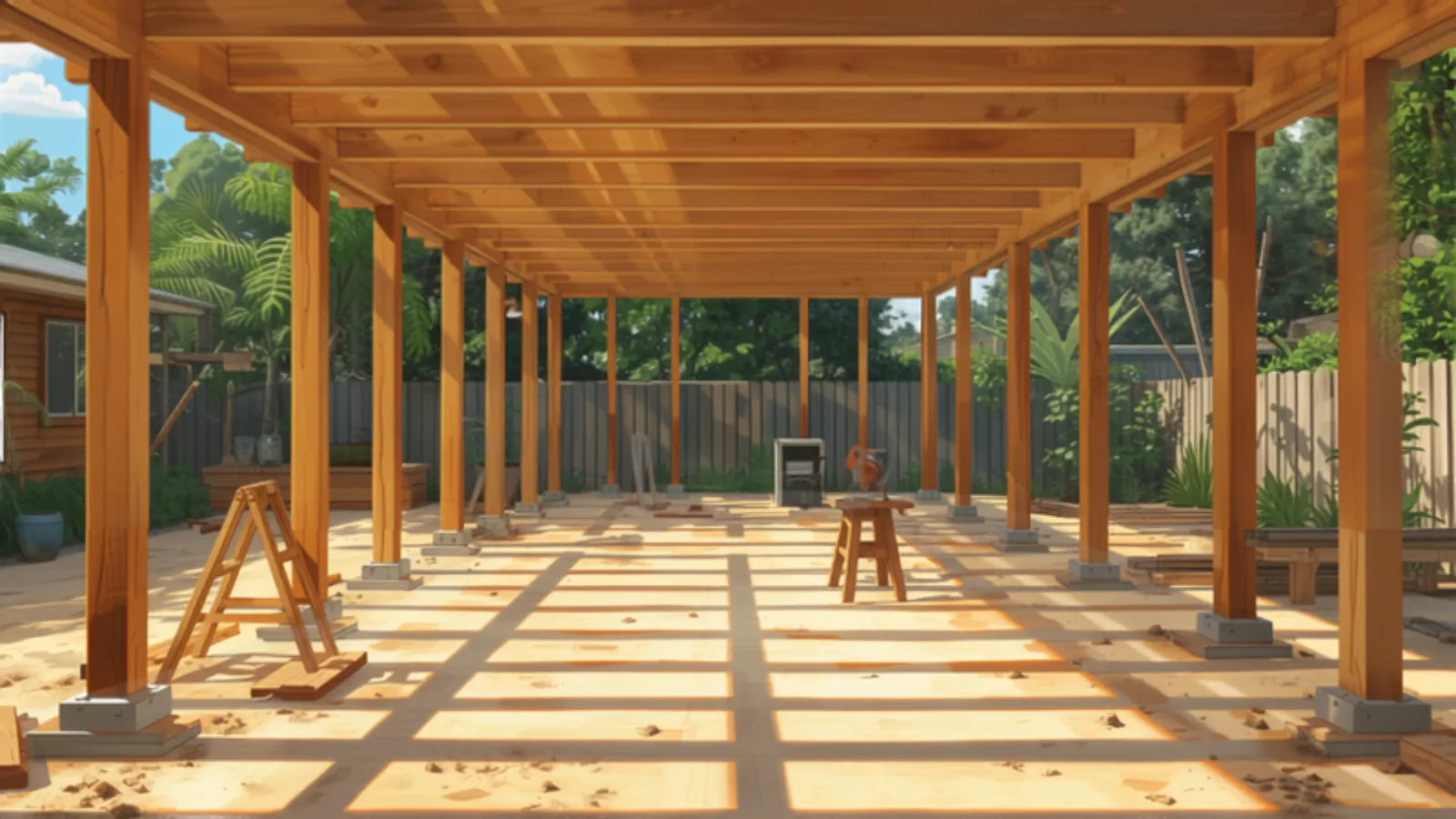
Roughly half of a deck's cost is the part you never see. A per-sqm rate covers, or should cover:
- Substructure. Posts, bearers and joists, sized and spaced to the span. On a sloping Gold Coast block this is a bigger share than on flat ground.
- Footings. Concrete footings to the depth the soil requires. Sandy coastal ground behaves differently to the clay further inland.
- Boards and fixings. The visible part, plus screws or a hidden fastening system.
- Labour. Setting out, cutting, laying, and the finishing detail at the edges.
What is usually not in a per-sqm rate: steps, balustrade, demolition of an existing deck, staining or oiling, electrical, and any council approval. Each of those has its own line, and a quote that looks cheap per metre often just has more of them sitting outside the number.
What the Gold Coast climate does to the maths
Two local factors change material selection here more than they would further south.
Termites. South-east Queensland carries high termite pressure, and it makes the substructure decision non-negotiable rather than optional. Treated pine used in ground contact needs the correct hazard-level treatment, and cutting corners there is a failure you discover years later when the deck moves. Any quote should say what treatment level the substructure timber carries.
Salt and UV. Closer to the water — Broadbeach, Burleigh, Palm Beach — salt air accelerates corrosion on fixings and hardware. Stainless fixings cost more and are worth it within a few streets of the beach. And the subtropical UV load means every timber deck here greys faster and needs recoating more often than the same deck in Melbourne would.
Neither factor changes the per-sqm rate much on its own. Both change which material is the right answer, which changes the rate a lot.
A worked example: 24 square metres in Burleigh
A 6 by 4 metre merbau deck off the back of a 1980s brick home, 600mm above ground on a gently sloping block. Line-itemised the way a good quote should be:
- Substructure and footings — treated pine posts, bearers and joists on concrete footings, sized for the span and treated for ground contact. Roughly $2,600.
- Merbau boards and fixings — 24 sqm of board plus stainless screws, given the proximity to the beach. Around $3,400.
- Labour — setting out, framing, laying and edge detail. Two trades, three days. About $3,800.
- Three steps down to the lawn — at $145 to $390 each, call it $700.
- Oiling — first coat, $24 to $59 per square metre, so $600 to $900.
That lands near $11,100 all up, against roughly $9,800 for the boards-and-substructure portion alone at the merbau typical rate. The gap is the steps and the oil — neither of which appears in a per-square-metre figure, and both of which you will want.
Change one variable and watch it move. Take the same deck to 1.2 metres above ground and you add a taller substructure, a balustrade at $120 to $345 per linear metre, and building approval — comfortably another $4,000 to $6,000. Same footprint, same boards, near enough half as much again.
Working out your own number
Measure the footprint in metres and multiply. A deck 6 metres by 4 is 24 square metres; at the merbau typical of $410 that is roughly $9,800 before steps, balustrade or approval.
Two adjustments worth making before you compare that to a quote. Add for height — anything more than about half a metre off the ground needs a taller substructure, and above a metre a balustrade is required rather than optional, and the cost climbs quickly. And add for shape: a rectangle is the cheapest thing to build, and every corner, curve, or cut around a tree or a pool edge adds labour that a flat per-sqm rate does not anticipate.
If you want the material decision worked through properly rather than as a price list, our composite versus timber decking cost guide sets out what each one actually costs to live with over ten years.
Where approval starts
In Queensland, a deck more than a metre above natural ground level generally needs building approval, and a licensed building certifier signs it off rather than the council directly. Below that height, most low-level decks do not — though covenants and body corporate rules can still apply, particularly in the newer Coomera and Pimpama estates.
Separately, Queensland Building and Construction Commission licensing applies to building work above $3,300, which almost every deck exceeds. Ask for the licence number and check it on the QBCC register before you pay a deposit. It takes a minute and it is the single most useful thing you can do with the quotes in front of you.
One note for the southern end of the territory: Tweed Heads is in New South Wales, so the approval pathway and the licensing body are different there. If your block is south of the border, confirm which rules apply before assuming Queensland's.
Where the money actually goes
Owners tend to assume the boards are the expensive part. On a typical Gold Coast deck they are roughly a third of it.
The substructure is usually the largest single line, and it is entirely invisible once the boards go down — which is precisely why it is the easiest place for a cheap quote to be cheap. Undersized bearers, joists spaced too wide, footings that do not go deep enough for the soil. None of it shows on handover day. All of it shows in three years as bounce, movement and cupped boards.
Labour is the next largest share, and it does not compress much. A deck is a lot of cutting, and the difference between a good deck and an obvious one is in the edges, the board spacing and how the corners are handled. That is time, and time is the thing a lower quote has usually removed.
Boards and fixings come third. It is the one line where paying more buys something you can see and touch, which is why quotes lead with the material — and why comparing on material alone tells you the least about which deck will still be flat in five years.
The practical consequence: if two quotes differ by 20 per cent, ask what the substructure specification is on each. That is nearly always where the difference is hiding, and it is the one component you cannot upgrade later without pulling the deck up.
Comparing quotes properly
Five things make two per-sqm quotes actually comparable:
- The material and grade, named — not just "hardwood"
- Substructure treatment level, and whether footings are included
- Fixings — stainless or galvanised, and hidden or top-fixed
- Steps and balustrade, in or out
- Whether approval and certification are the builder's job or yours
That last one is worth pinning down in writing. Approval is the owner's legal responsibility, and a builder who arranges it is doing you a service rather than discharging an obligation — which means it can quietly fall off a quote without anyone noticing until an inspection.
Ask for the quote broken into those lines rather than as a single figure. Any builder working properly can produce it, because it is how they priced the job in the first place. A refusal to itemise is not always a warning sign, but it does make the quote impossible to compare against anything, and it removes your only way of seeing which corner is being cut.
One last thing worth doing before you commit: ask to see a deck they built three or four years ago rather than a recent one. Anyone can hand over a deck that looks good the week it was finished. The Gold Coast climate is unusually hard on timber, and a deck that is still flat, tight and unsplit after a few summers here tells you more about the substructure than any quote can.
Frequently asked questions
How much does decking cost per square metre on the Gold Coast?
$175 to $590 per square metre supplied and installed. Treated pine is $175 to $345, merbau $295 to $540, spotted gum $345 to $590, and composite $275 to $540.
Why is my small deck more expensive per square metre?
Fixed costs — setup, delivery, edges, substructure design — do not scale with size. A 15 sqm hardwood deck works out near $490/sqm at typical pricing, while the same build at 40 sqm is closer to $465/sqm.
What is included in a per-square-metre decking rate?
Substructure, footings, boards, fixings and labour. Usually excluded: steps, balustrade, demolition of an old deck, oiling or staining, electrical, and any building approval.
Do I need council approval for a deck in Queensland?
Generally yes if it sits more than a metre above natural ground level, signed off by a licensed building certifier. Below that, most low-level decks don't — though covenants and body corporate rules can still apply.
How do I estimate my own deck cost?
Multiply the footprint in metres by the material rate — a 6 by 4 metre deck is 24 sqm, or roughly $9,800 in merbau at typical pricing. Then add for height, steps, balustrade and any non-rectangular shape.
← Back to Gold Coast decking cost guide hub