Pool heating cost in Melbourne

Melbourne has the shortest unheated swim season of any mainland capital. Without heating, a backyard pool here is genuinely comfortable for about ten weeks — late December to early March, and less in a poor summer. Heating is what turns that into six or seven months, and it is the single biggest lever on how much a Melbourne pool actually gets used.
Installed in 2026: solar $2,625 to $6,300, heat pump $3,150 to $7,900; gas heaters are not in our Melbourne table, so get them quoted. The install price is the easy half of this decision. The running cost is where Melbourne changes the answer.
What each system costs to install
- Solar — $2,625 to $6,300. Black polymer collectors on the roof, a diverter valve and a controller. Price scales with collector area and roof complexity: a single-storey tile roof with a clean north face is the low end, a two-storey or split-orientation roof needing extra plumbing runs is the top.
- Heat pump — $3,150 to $7,900, typically around $5,250. Driven by unit output in kilowatts, which is sized to pool volume. Add electrical work if the switchboard needs a dedicated circuit, which on older Melbourne housing stock is common.
- Gas — quoted per job: gas heaters are not priced in our Melbourne table. Expect gas line work on top if the meter is undersized or a long run is needed.
Running cost is the real decision
Our Melbourne table prices the install, not the running cost, which depends on your tariff, pool size, season and target temperature — ask each installer to estimate it for your pool. From cheapest to dearest to run:
- Solar — cheapest to run. You are only paying to run the pump a little longer. There is no fuel.
- Heat pump — in between to run, least in midsummer and most in a cold snap. A heat pump moves heat rather than making it, so it returns roughly four to six units of heat per unit of electricity.
- Gas — dearest to run in active use. Gas heats fast, which is its whole advantage, but every megajoule is bought.
Over a Melbourne season those running costs separate hard, so weigh them alongside the install price: ask each installer for a season's running-cost estimate on your own tariff.
Where solar struggles in Melbourne
Solar pool heating is the cheapest system to run anywhere in Australia, and in Brisbane or Perth it is close to a default. Melbourne is a harder case, for two reasons.
The first is that it needs roof area — as a rule of thumb, collector area of roughly 80 to 100 per cent of the pool's surface area, north-facing, unshaded. A lot of Melbourne housing does not have that, particularly on smaller inner-suburban blocks where the pool is squeezed beside a single-storey extension with the good roof face already carrying photovoltaic panels.
The second is that solar heats when the sun is out, which in Melbourne is not reliably when you want to swim. It will extend your season at both ends and it will do it for almost nothing, but it will not hold a set temperature through a cold week in October. For many Melbourne owners the honest answer is that solar is an excellent season-extender and a poor thermostat.
Heat pumps and Victorian electrification
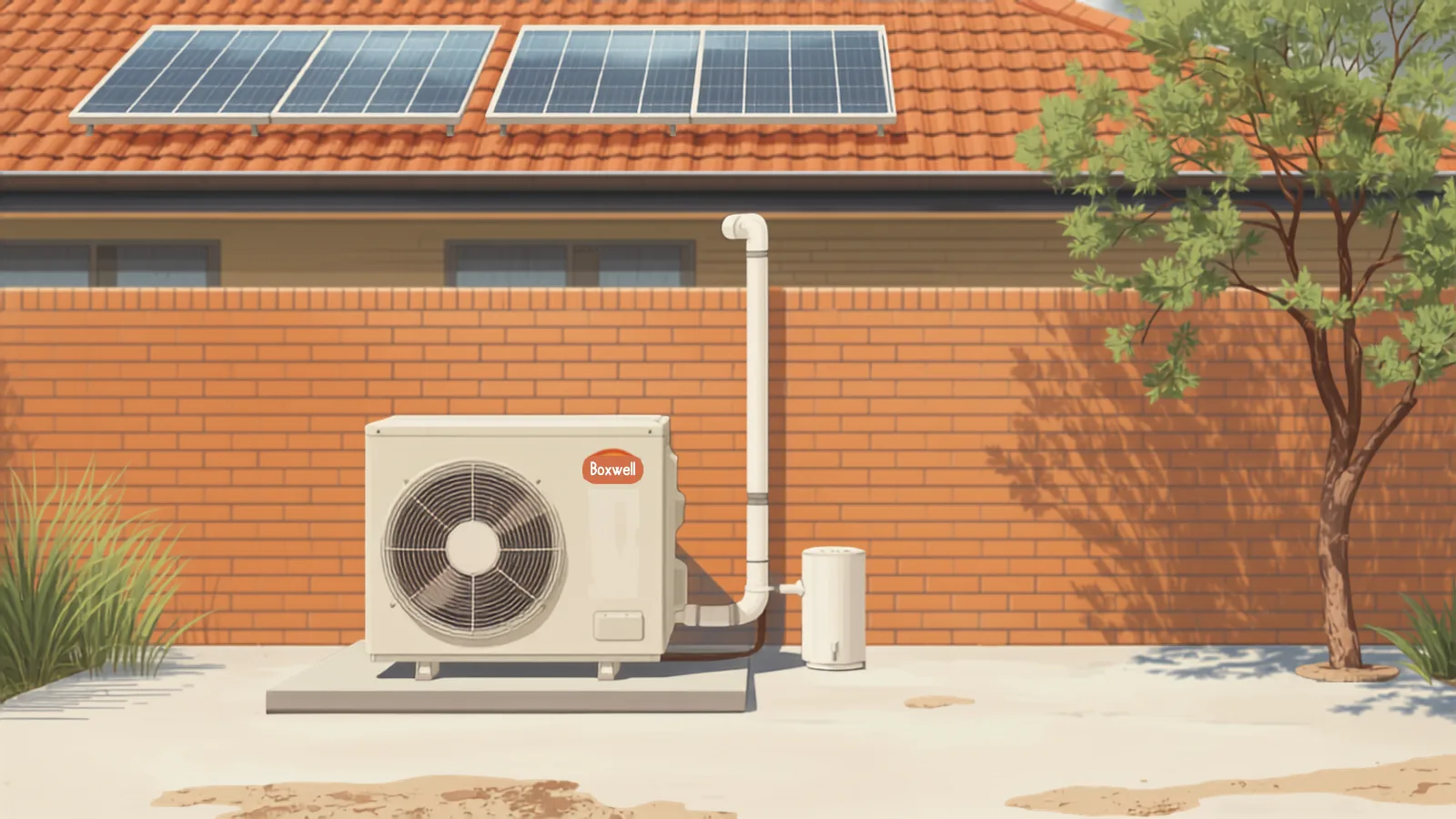
Victoria has been steadily moving new residential energy demand off gas, and a pool heater is a large discretionary gas load that draws attention in that context. Practically, if you are already replacing appliances or have solar photovoltaic panels on the roof, a pool heat pump running on daytime self-generated electricity is close to the cheapest heat available.
Two things to check before committing. Heat pump output falls as air temperature drops, so a unit sized for a Sydney climate will underperform in a Melbourne July — insist the sizing is done on local design temperatures. And they are not silent; a unit under a bedroom window or hard against a boundary fence is a neighbour conversation waiting to happen.
Sizing, target temperature and heat-up time
Most Melbourne owners settle on 26 to 28 degrees. Below 25 the pool reads as bracing rather than pleasant; above 28 the cost curve steepens sharply, because heat loss scales with the gap between the water and the air, and Melbourne nights are cool for most of the season. Every extra degree you hold is bought twice — once to get there, and again every night to stay there.
Sizing is done on surface area, not volume, which surprises people. Heat leaves a pool almost entirely through the surface, so a wide shallow pool is harder to heat than a narrow deep one holding the same water. A quote that asks only how many litres you have has not asked enough.
Heat-up time from cold varies enormously by system:
- Gas — hours. This is its one real advantage: it suits people who swim occasionally and want the pool warm this afternoon.
- Heat pump — 24 to 72 hours from cold for a typical pool. It is a hold-temperature device, not an on-demand one. Run it continuously through the season and let the thermostat manage it.
- Solar — days, and only on the days the sun cooperates.
The Melbourne detail that undoes people is overnight loss. An uncovered pool can shed two to four degrees between dusk and dawn in October or April, which is most of what a heat pump gained during the day. That is the entire reason a blanket is not optional here.
The common quote trap is undersizing. A smaller unit is cheaper on the invoice and looks like the same product, but it runs continuously and never quite reaches target on cool days — so you pay for electricity all season and swim in a pool that is almost warm enough. Insist the sizing calculation is shown, and that it uses Melbourne design temperatures rather than a generic national figure. A unit specified for a Brisbane climate will disappoint you here in a way that is expensive to fix afterwards.
The cheapest heating you can buy
A pool blanket. It is not really heating, but an uncovered Melbourne pool loses the majority of its heat overnight through evaporation, and a blanket cuts that dramatically. Blankets and rollers are not in our Melbourne table, so get a quality cover quoted.
Running any heater without a blanket in Melbourne is close to heating the sky. Every operator worth listening to will say the same thing.
Running the heater on your own solar
If you already have photovoltaic panels on the roof, the arithmetic on a pool heat pump changes substantially, and this is where most Melbourne owners get the best result available to them.
A heat pump is a large, flexible, daytime load. Feed-in tariffs in Victoria have fallen far enough that exported electricity earns very little, so power you consume yourself is worth more than you would be paid for sending it out. Shifting the heat pump and the filtration pump into the middle of the day turns surplus generation into water temperature rather than a token export credit.
In practice that means setting the heat pump to run roughly 10am to 4pm rather than overnight or on a cheap-rate window. It is the opposite of how people instinctively schedule pool equipment, and it is worth resetting the timer deliberately — a heat pump inherited on a previous owner's schedule is frequently running at exactly the wrong time of day.
It also happens to be when a heat pump works best. Output falls as air temperature drops, so a unit running at 2am in October is fighting the coldest air of the day at the worst efficiency it will see. Daytime running is both cheaper and more effective, which is an unusually clean alignment of incentives.
Two caveats. A heat pump drawing three to four kilowatts will consume most of a modest rooftop array on its own, so if you also want the dishwasher running and the car charging from the same surplus, something has to give. And on an overcast Melbourne day you are simply buying grid power at retail — the strategy improves your average cost, it does not eliminate it.
If you have not yet committed to panels, run the two decisions together rather than sequentially. A pool heat pump is often the single largest discretionary load a household adds, and it changes what array size makes sense.
What heating does to your maintenance bill
Warmer water is more chemically active water. Chlorine burns off faster, pH drifts more, and the season during which the pool needs real attention gets longer. A heated Melbourne pool is effectively a year-round pool, and the service schedule needs to reflect that rather than dropping to a winter minimum.
Worth knowing if you run salt: chlorinator cells lose efficiency in cold water, which changes what a heated pool needs through winter. That interaction is covered in our saltwater versus chlorine cost guide for Melbourne, and the pump-hours side of it in the pump and filter guide.
Frequently asked questions
How much does pool heating cost to install in Melbourne?
Solar runs $2,625–$6,300 installed and heat pumps $3,150–$7,900, with most around $5,250, in our Melbourne table. Gas is not priced there, so get it quoted along with any gas line work. Install price is only half the decision — running cost separates them much harder.
What is the cheapest way to heat a pool in Melbourne?
Solar, by a wide margin: the only running cost is the pump running a little longer. The catch is roof area and reliability: it needs unshaded north-facing collector area roughly the size of the pool, and it heats when the sun is out rather than when you want to swim.
How much does a pool heat pump cost to run per day?
It depends on your electricity tariff, the season and your target temperature, so ask the installer to estimate it for your pool on your own tariff — our Melbourne table prices the install, not the running cost. A heat pump moves heat rather than generating it, returning roughly four to six units of heat per unit of electricity, and a blanket cuts the heat it has to replace overnight.
How long is the swim season in Melbourne with heating?
Unheated, roughly ten weeks from late December. With a heat pump and a pool blanket, most Melbourne owners get six to seven months, typically October through April.
Do I need a pool blanket if I have a heater?
Yes, and it is the highest-return money you will spend. An uncovered Melbourne pool loses most of its heat overnight through evaporation, so running a heater without a cover wastes a large share of what you are paying for.
← Back to Melbourne pool maintenance cost guide hub