Palm tree removal cost on the Gold Coast

Removing a palm on the Gold Coast typically costs $245 to $1,175, with most jobs landing around $390. Palms are lighter than hardwoods but bring their own quirks — height, fibrous trunks, heavy seed heads, and self-seeding cocos palms the council would rather you took out.
Quick answer — palm tree removal cost on the Gold Coast
| Palm height | Typical Gold Coast range (2026) |
|---|---|
| Small (under 4 m) | $245 – $450 |
| Medium (4–8 m) | $450 – $750 |
| Tall (8–12 m) | $750 – $1,000 |
| Very tall (12 m+ or tight / canal access) | $1,000 – $1,175+ |
You're in.
A local installer will be in touch about your job. No spam, no middleman.
Why palms are priced differently from trees
A palm is not a woody tree. It has a single fibrous trunk, no spreading branches, and far less weight for its height, so it usually comes down faster and produces much less disposal tonnage than a hardwood of the same height. That keeps palm removal at the lower end of the per-tree range. What drives a palm quote instead is height and access — tall palms have to be climbed and taken in sections — plus the weight of the seed head, and on some species the spines that slow a climber down.
Common Gold Coast palms
Cocos (queen) palm
The most common removal on the Gold Coast, and for good reason: the cocos palm is widely treated as a weed. It self-seeds aggressively, drops messy fruit that stains paving and feeds rats and flying foxes, and pops up unwanted across gardens and bushland. Many homeowners remove them specifically to stop the spread.
Alexandra and Bangalow palms
Tall, slender feather palms seen all over Gold Coast gardens and canal estates. Straightforward to remove but often very tall, which pushes them up the height bands.
Foxtail and date palms
Foxtails are popular and tidy; date palms (and some others) carry sharp spines on the fronds or trunk base that make a removal slower and a little dearer.
Washingtonia (cotton) and cabbage tree palms
Washingtonia palms grow very tall and hold a thick skirt of dead fronds that adds weight and fire risk; they are common across older Gold Coast streets and gardens and almost always need a climber. Native cabbage tree palms are slower-growing and generally smaller. As a rule of thumb, the taller and more fibrous the palm and the heavier its crown of retained fronds, the more it sits toward the upper end of its height band.
What affects your palm quote
Height is the biggest lever — a 3-metre palm can be cut from the ground, while a 12-metre one needs a climber and sectional lowering. Access matters just as much: canal-front blocks in Surfers Paradise and Paradise Point, narrow side passages, and palms tucked against the house all add time. A heavy fruiting seed head adds weight to lower safely, and the number of palms changes the per-palm price because the call-out is shared. The stump is usually quick to grind, though the fibrous material can be slow.
Disposal and the self-seeding problem
Palm fronds and trunk sections are chipped or carted as green waste. With cocos palms there is an extra reason to remove the seed head carefully: the fruit is full of seed that will sprout wherever it lands, so a tidy removal stops the palm coming back next door. Confirm green-waste disposal is included in your quote rather than left on the verge.
One more Gold Coast-specific factor is the waterfront. On a tight Surfers or Paradise Point canal lot the only drop zone may be a narrow strip between the house and the water, so every frond and trunk section has to be lowered on ropes rather than dropped, and waste is often carried back through a side passage to the truck. That access premium is why an otherwise ordinary palm can land at the top of its height band on the canal.
How a palm removal works
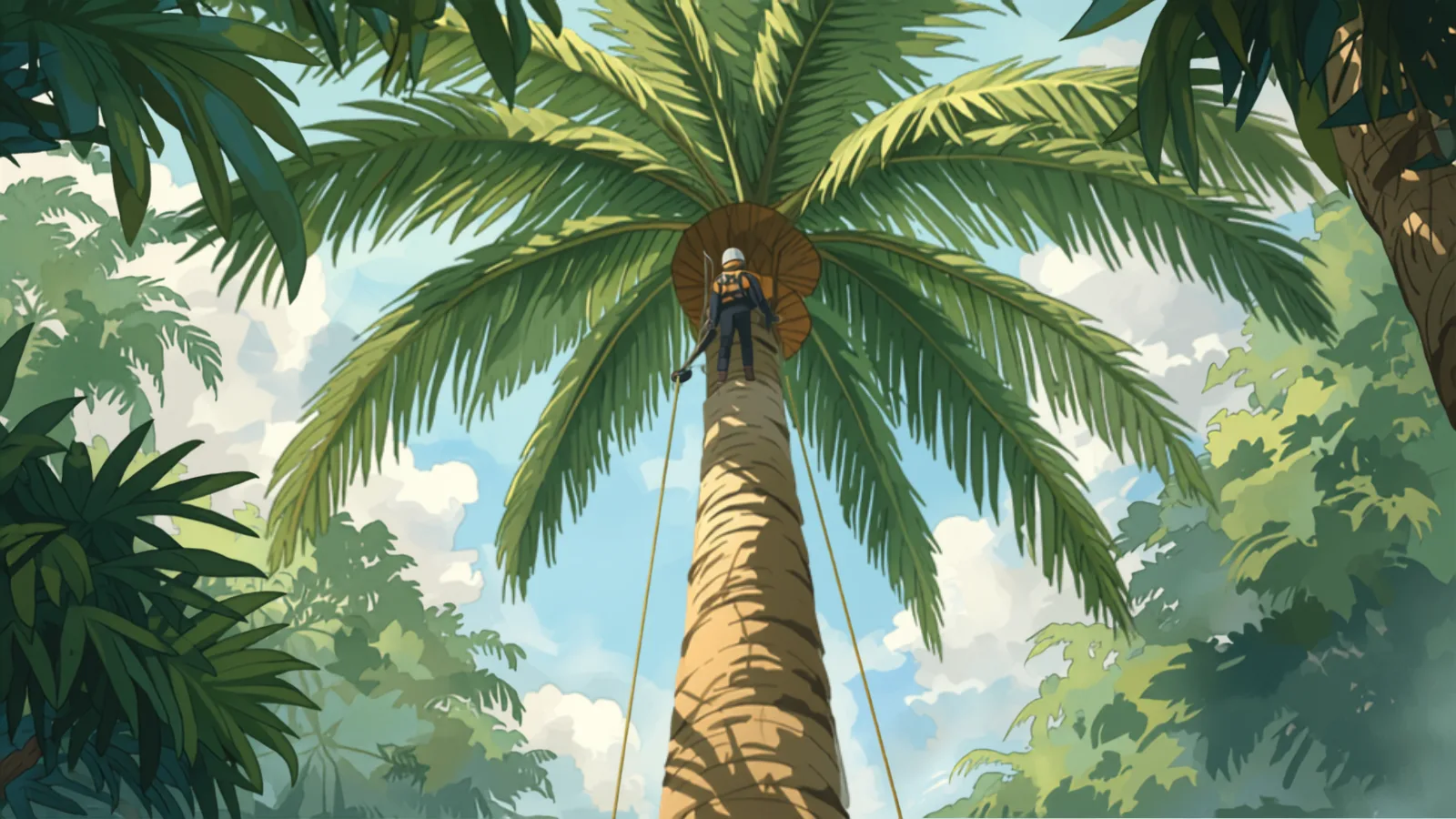
For a short palm the crew may simply cut it down near the base and section the trunk on the ground. For anything tall, a climber ascends with spikes and a harness, takes off the fronds and seed head first to remove the weight and the hazard from the crown, then takes the trunk down in manageable sections, lowering each piece where there is no clear drop zone. The trunk and fronds are fed through a chipper or cut for haulage, and the stump is ground separately if you have asked for it. The whole job is usually a few hours, with height and access setting the time.
Palms, storm season and the Gold Coast climate
Palms are built for the tropics, but on the Gold Coast they bring seasonal jobs of their own. Through the November-to-April storm season a tall palm's dead fronds and heavy seed heads become projectiles in high wind, and a leaning or root-loosened palm near the house is a genuine hazard. Cocos palms in particular hold large, heavy bunches of fruit that can fall without warning onto paths, cars and people below. If you are not removing a palm outright, regular frond-and-seed removal before storm season is the cheaper maintenance alternative — but for a palm that is too tall to manage, too close to the house, or simply unwanted, removal ends the problem for good.
Remove, or transplant?
Smaller palms can sometimes be transplanted rather than removed, and a healthy, sought-after palm in an accessible spot may even have resale value to a landscaper. But transplanting a large palm is specialist work — it needs machinery, careful root-ball preparation and somewhere for it to go — and is rarely cheaper than removal once you count the crane or excavator time. For most Gold Coast homeowners dealing with an overgrown or weedy cocos, straight removal is the practical choice.
Disposal and the cocos problem in detail
Cocos palms earn their reputation at disposal time. The seed heads carry hundreds of viable seeds, and if they are dropped or chipped carelessly the palm effectively replants itself across your garden and the bushland next door — which is one reason councils and landcare groups encourage their removal. A proper removal contains or bags the seed heads, chips the fronds and trunk, and carts the green waste away rather than leaving it to spread. Confirm disposal is included so you are not left with a pile of seed-laden fronds on the verge. And remember the rules still apply: whether you need approval depends on the palm's size, where it sits on your block and your property's overlays, so check the council position — see our Gold Coast permits guide — before removing any palm that might be protected.
Illustrative example — a cocos palm in Surfers Paradise
A representative Gold Coast job, not a specific quote: one 9-metre cocos palm on a canal-side block in Surfers Paradise with tight access between the house and the water.
| Line item | Cost |
|---|---|
| Access assessment & quote | $0 |
| Sectional climb & dismantle | $620 |
| Frond & trunk chipping / haulage | $180 |
| Stump grind (palm) | $160 |
| Total | $960 |
The same palm on an open block with kerbside access would sit a few hundred dollars lower; the tight canal-side access is what lifts it toward the top of the tall-palm band.
Frequently asked questions
Why is palm removal often cheaper than tree removal?
Because a palm has a single fibrous trunk and no heavy branches, so it weighs far less than a hardwood of the same height, comes down in sections quickly, and produces much less material to cart away. Height and access, not weight, are what drive a palm quote up.
Do I need council approval to remove a palm on the Gold Coast?
It depends on the palm’s size (the City Plan’s assessable-vegetation test is more than 4 metres tall, or a trunk more than 40 centimetres around at 1.3 metres above the ground) and on whether it is mapped on the Vegetation Management Overlay Map, not the fact that it is a palm. Self-seeding cocos palms are often treated as weeds and may be exempt, but other palms above that size, or on land mapped on the Vegetation Management Overlay Map, can still be protected. Check the City of Gold Coast rules — see our permits guide — before removing one.
Should I remove my cocos palm?
Many Gold Coast owners do. Cocos (queen) palms are widely regarded as a weed: they self-seed aggressively, drop messy staining fruit, and feed rats and flying foxes. Removing one stops it spreading seed across your garden and neighbouring bushland.
How much does it cost to remove a very tall palm?
Tall palms over 12 metres, or any palm with tight or canal-side access, typically run $1,000 to $1,175 or more, because they must be climbed and taken down in roped sections rather than cut from the ground. Open, kerbside-access palms cost less for the same height.
Is the stump included in palm removal?
Usually not — grinding the stump is generally a separate charge, often around $145 to $250 for a palm. Palm stumps grind quickly but the wet, fibrous material can be slow on the wheel. Confirm whether the stump is in your quote or extra.
← Back to Gold Coast tree removal cost hub